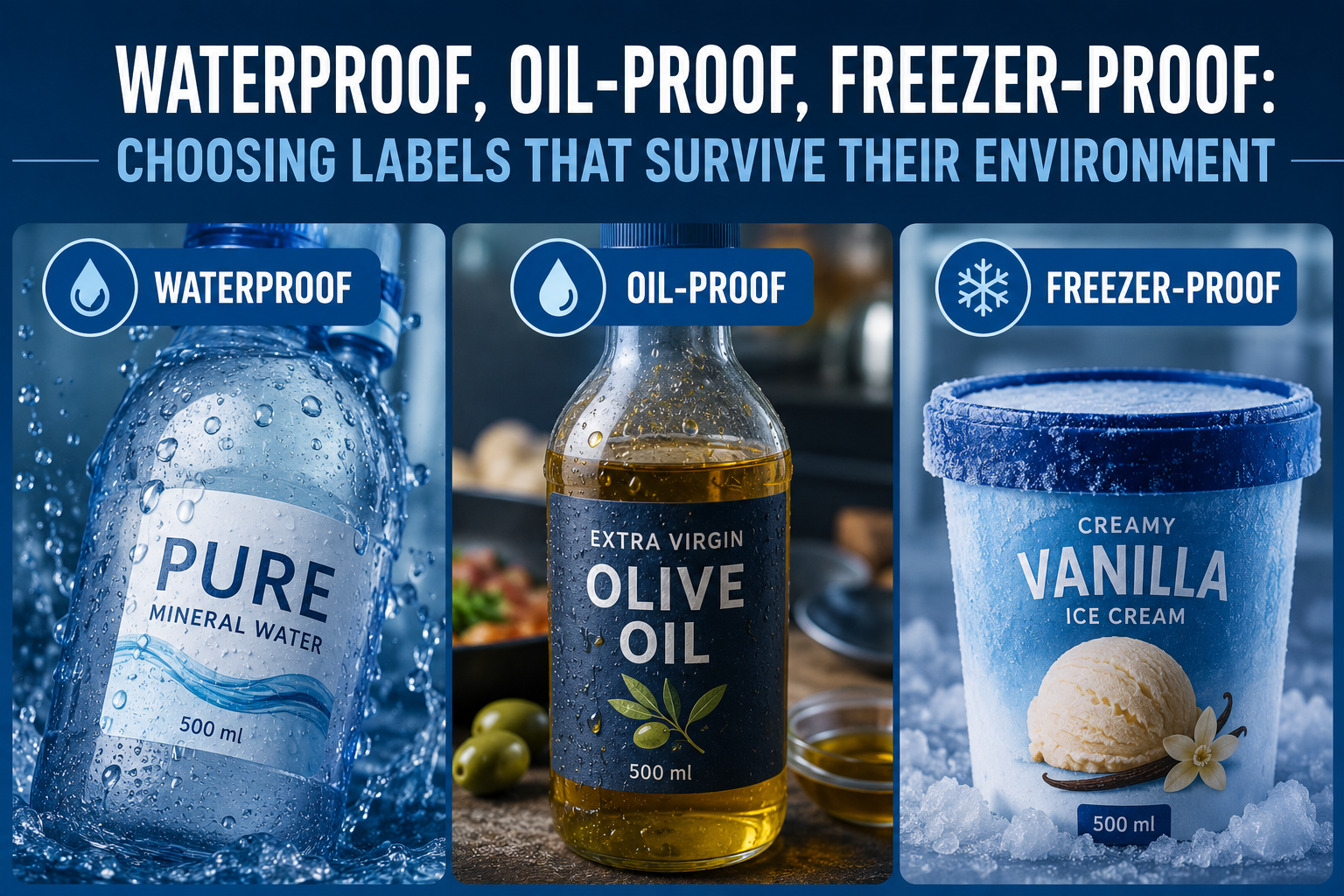

Brands often treat these three words as one big claim. Waterproof, oil-proof, freezer-proof, all lumped together as tough label, no worries. That is not how it works. Each word describes a different threat, and each threat needs its own fix in the film, the adhesive, or both. A label built to survive a fridge can still fail on an oily bottle. A label built to resist oil can still lift off in a freezer. Knowing the difference between waterproof, oil-proof, freezer-proof labels before you print saves a reprint after launch.
Waterproof and Water-Resistant Are Not the Same Claim
Water-resistant means a label can handle brief contact with water and still look fine. Waterproof means it can survive prolonged exposure, like sitting in a chiller cabinet with condensation running down the bottle all day. Paper labels fail this test almost immediately, since the fibres absorb moisture and the print smears, or the paper itself softens and lifts.
Synthetic films like BOPP solve this at the facestock level, because the film does not absorb water the way paper does. But the facestock is only half the answer. The adhesive underneath also needs to hold under wet conditions, or the label can look intact while quietly losing its grip at the edges.
Oil-Proof Is a Separate Problem From Waterproof
A label that survives water can still fail on an oily product. Oil behaves differently. It creeps under the edges of a label slowly, working its way inward until the print turns translucent or the label lifts entirely. This is why cooking oils, sauces, cosmetics, and cleaning products need labels specified for oil resistance, not just water resistance.
A synthetic facestock helps, but the real protection comes from lamination or a UV varnish coating on top of the print. That top layer is what actually blocks oil from reaching the ink underneath. Skipping this step is one of the most common reasons a label looks fine at the point of packing and turns patchy or see-through by the time a customer is halfway through the bottle.
Freezer-Proof Is Mostly About the Adhesive
People assume a freezer-proof label just needs a tougher film. The bigger challenge is actually the adhesive. Standard adhesives are formulated to bond at room temperature. They can lose their grip in cold storage, or fail to bond at all if applied to a chilled or frosted surface. Freezer-grade adhesive is a different formulation, built to stay flexible and stay stuck well below zero.
Two details matter here that brands often miss. First, the label needs to be applied at the right surface temperature, since sticking a label onto a bottle that is already ice-cold can stop the adhesive from bonding properly in the first place. Second, condensation during the freeze-thaw cycle can work its way under a label that was not specified with freezer-grade adhesive from the start, even if the film itself is fully waterproof on its own.
Application Conditions Matter as Much as the Material
A label can be specified correctly and still fail, if it goes onto the container the wrong way. Surface preparation is the biggest factor here. A bottle with any trace of moisture, dust, or oily residue on it will weaken adhesion before the label even has a chance to bond properly.
Many labels that peel off within the first two weeks are not a material failure at all. They are an application failure, caused by a surface that was not clean and dry at the moment of contact. This is worth checking early, since it is a production line issue, not a label design issue, and no amount of upgrading the film or adhesive spec will fix it on its own.
Specify for the Actual Product, Not the Category
The safest approach is to specify a label for what the product actually does, not for the general category it sits in. A drink that lives in a cooler needs waterproof film and a cold-tolerant adhesive. A cooking oil needs oil resistance built into the top coating, not just a waterproof base film. A frozen product needs freezer-grade adhesive and a realistic plan for how the label gets applied without an ice-cold or wet surface working against it.
Testing a label on the actual container, under the actual storage condition, catches problems that a flat sample sheet never will. That one extra step, before a full production run, is usually the difference between a label that performs and one that needs a reprint.
FAQs
What is the difference between waterproof and water-resistant labels?
Water-resistant labels handle brief or occasional contact with water. Waterproof labels are built to survive prolonged exposure, such as sitting in a chiller with constant condensation, without the film breaking down or the adhesive losing grip.
Can a label be waterproof but not oil-proof?
Yes. Water resistance and oil resistance are different specifications. A label can hold up fine against moisture and still let oil creep under its edges, since oil resistance depends mainly on the lamination or coating over the print, not the base film alone.
Why do freezer labels need special adhesive, not just special film?
Standard adhesives are formulated to bond at room temperature and can lose their grip in cold storage. Freezer-grade adhesive is a separate formulation designed to stay flexible and stay bonded well below zero, which matters more than the film in most freezer failures.
Why do waterproof labels sometimes peel off within a few weeks?
This is usually an application problem, not a material problem. Applying a label to a surface with residual moisture, dust, or oily residue weakens the bond from the start, regardless of how durable the label material itself is.