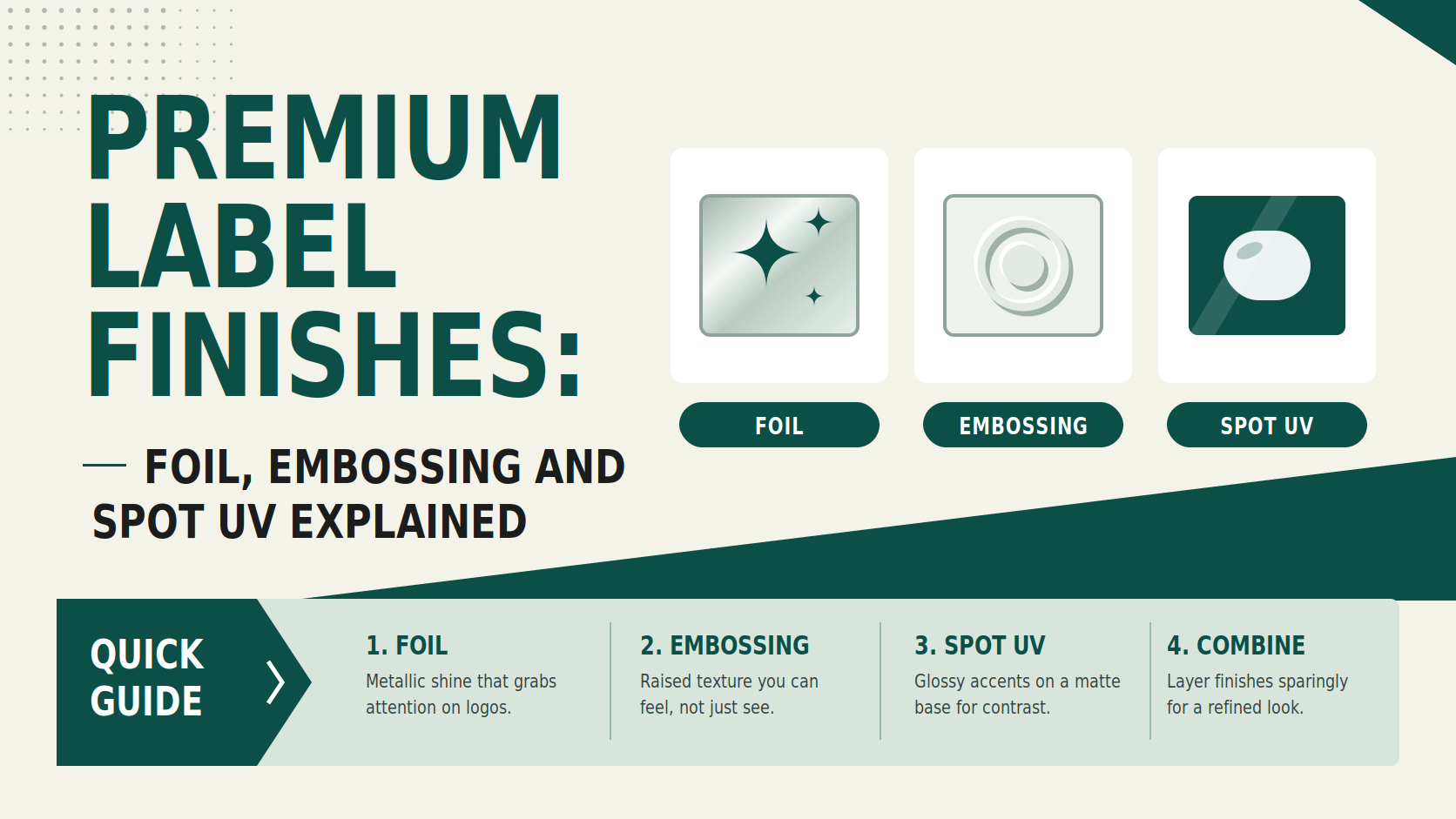

A label holds the power to make your product look premium and classy. However, the right kind of feel and finish makes all the difference to the aesthetics you seek for your product. Let’s understand which one: foil, embossing, spot UV, works the best for you. Foil adds shine to chosen parts of a label. Embossing raises parts of the design so you can feel them. Spot UV adds a glossy, raised-looking coat on selected areas. Used with restraint, they make a label look and feel more expensive. Used on everything, they make it look busy.
Why Finishes Change How A Product Is Judged
A shopper decides in a few seconds. Before they read a word, they look at the pack and often pick it up. A label that catches the light or feels different in the hand sends one message: this product is worth more.
That is what premium finishes do. They don’t change what is inside the pack. They change how people feel about it.
Foil Stamping: Shine In The Right Places
Foil stamping presses a thin metallic layer onto the label using heat and pressure. A metal die decides the shape. The result is a sharp, bright patch of gold, silver, copper, or a colour. Holographic foils are also available.
It works best on small, important details, such as a logo, a brand name or a border. Those are the things you want the eye to find first.
Foil is different from metallised film. Metallised film makes the whole label shiny. Foil adds shine only where you want it, which usually looks more refined. (Our guide to label films covers metallised film in detail.)
A few things to keep in mind. Very thin lines and tiny text can fill in or lose sharpness, so keep foil elements bold and simple. Never put foil over a barcode, as the shine makes scanning difficult. And foil needs a die made for your design, which adds a one-time cost.
Embossing: A Design You Can Feel
Embossing raises part of the label above the surface. Debossing does the opposite and presses it in. Both use a metal die and pressure.
People often touch an embossed logo without thinking. That small touch builds a stronger memory of the brand than print alone.
Embossing works best on thicker, firmer label materials, such as many paper labels. Thin, stretchy films don’t always hold a raised shape well, so the effect can be softer. Ask your printer to show you a sample on your chosen material, as results differ.
Embossing and foil work well together. The foil gives shine, and the embossing gives depth. This pair is common on premium cosmetics, spirits and gift packs.
Spot UV: Gloss Where You Choose
Spot UV is a clear, glossy coating applied only to selected areas. It is dried under UV light. The rest of the label stays as it is, often matte.
The power of spot UV is contrast. A matte label with a glossy logo or pattern looks sharp. Light plays on the glossy part and makes it stand out.
It suits logos, patterns, product names or a single feature, such as a leaf or a bottle shape. It is one of the more affordable finishes, because it needs less tooling than foil or embossing in many setups, though this depends on the printer and the job.
Do not confuse it with full coatings. Lamination and varnish protect the whole label. Spot UV is used for effect on small areas. We compare the full coating options in a separate guide.
Quick Comparison Between Foil, Embossing, Spot UV
| Foil stamping | Embossing | Spot UV | |
| What you notice | Metallic shine | Raised or pressed texture | Glossy patches |
| Best for | Logos, borders, names | Logos, patterns, textures | Contrast on matte labels |
| Needs a die | Yes | Yes | Usually a screen or digital file |
| Best material | Paper and many films | Thicker paper | Most label materials |
| Main risk | Fine details lose sharpness | Weak effect on thin film | Looks flat on glossy labels |
Material suitability depends on the exact stock and print method, so confirm with a sample.
How To Pick The Right One
Start with your brand. A quiet, natural product may suit embossing or a soft matte label with small spot UV. A bold, festive or luxury product may suit foil.
Next, look at your budget and run size. Foil and embossing need dies, so the one-time cost is spread better across a larger run. For a small batch, spot UV or a simple design may give you more for your money.
Then think about the label itself. Check the material, the colour and how it will be handled. A finish that looks great on a dry shelf may not survive a wet, cold or rubbed surface.
Mistakes Brands Often Make
The most common one is using too much. Foil, embossing and spot UV all on one label can look cluttered. Pick one hero detail and let the rest stay simple.
The second is using finishes on the wrong detail. Putting foil on small body text makes the label harder to read. Put it on the logo instead.
The third is skipping the proof. Finishes look different in real life than on screen. Always approve a physical sample before the bulk run.
Frequently Asked Questions
Is foil stamping expensive?
It costs more than plain printing, mostly because of the die made for your design. Over a large run, that cost spreads out. For small runs, use foil on one small detail only, or consider other finishes.
Can I emboss any label material?
Not equally well. Thicker, firmer materials hold a raised shape better. Thin, flexible films give a softer result. Ask for a sample on your chosen material.
What is the difference between spot UV and normal lamination?
Lamination covers the whole label and protects it. Spot UV coats only chosen parts for visual effect. Many labels use both, with matte lamination and glossy spot UV on the logo.
Can I combine foil, embossing and spot UV?
Yes, but use them carefully. Two finishes often work well together, such as foil and embossing. Using all three on one small label usually looks crowded.
Want a label that looks as good as your product?
Share your product, pack and budget with the Winways Digitech team. We will suggest finishes that suit your brand and show you samples before you commit. Reach us through the contact page on our website.