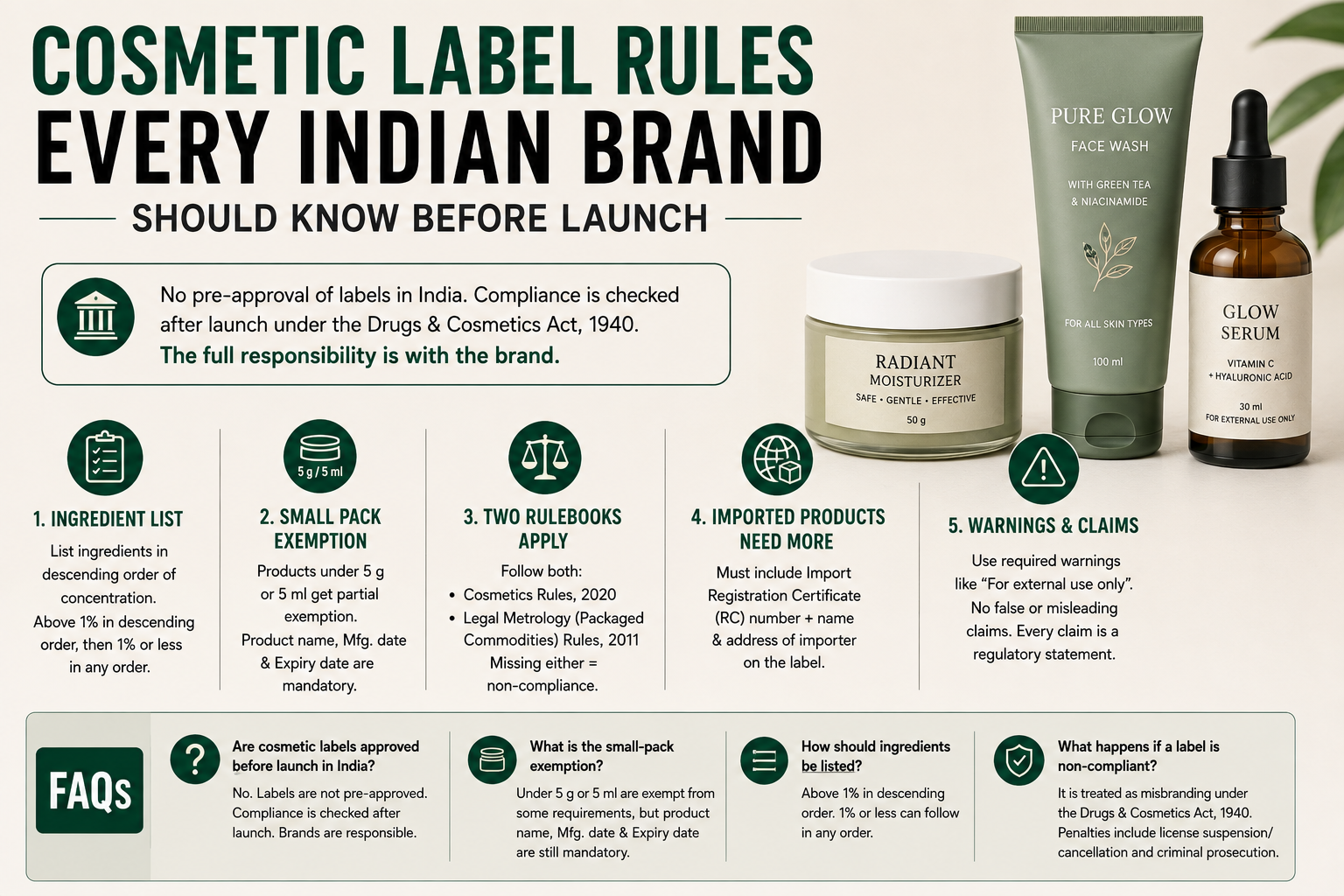

India does not approve cosmetic labels before a product goes on sale. This surprises a lot of new brands. The Cosmetics Rules, 2020 set the requirements, but no authority checks a label before launch. Compliance is checked after the product is already in the market, through the State Licensing Authority for domestic products and the Central Drugs Standards Control Organization for imports. That means the full responsibility sits with the brand. A missed declaration does not get flagged at approval stage. It gets flagged as misbranding under the Drugs and Cosmetics Act, 1940, and the consequences range from a license suspension to criminal prosecution. Here are the cosmetic label rules that brands must take note of.
Rule 1: The Ingredient List Has a Specific Order
Every cosmetic sold in India needs a full list of ingredients on the label, and the order is not optional. Ingredients present above 1 percent concentration must be listed in descending order. Ingredients at or below 1 percent can follow in any order after that. Brands often list ingredients the way their formulation sheet does, or the way a supplier hands it over, without rearranging for this rule. That mismatch is one of the most common label failures for new cosmetic brands, and it is also one of the easiest to catch during any compliance review.
Rule 2: Small Packs Get Some Exemptions, Not All of Them
Cosmetics under 5 grams or 5 millilitres get some relief from full labelling requirements. This applies to sample sizes, trial packs, and travel minis. But the exemption is partial, not total. The product name, manufacturing date, and expiry date still need to appear on the label even at this size. Brands sometimes treat the small-pack exemption as a free pass to skip labelling almost entirely. That reading is wrong, and it is a common reason sample and travel-size SKUs fail compliance even when the full-size version of the same product is fully compliant.
Rule 3: Two Different Rulebooks Apply at Once
Cosmetic labels in India have to satisfy two separate regulations at the same time. The Cosmetics Rules, 2020 cover product-specific declarations like ingredients, manufacturing license number, and usage warnings. The Legal Metrology (Packaged Commodities) Rules, 2011 cover commercial declarations like maximum retail price, net quantity, and customer care contact details. A label can meet every requirement under one set of rules and still fail under the other. Brands that only check their label against one regulation, usually the Cosmetics Rules since it feels more product-specific, often miss the Legal Metrology declarations entirely.
Rule 4: Imported Cosmetics Carry Extra Declarations
If a cosmetic is imported into India, the label needs everything a domestically made product needs, plus more. This includes the import registration certificate number, along with the name and address of the importer. Brands that manufacture abroad and simply relabel with an Indian distributor’s contact details, without adding the RC number, are missing a mandatory field. This is a frequent gap for smaller international brands entering India through a local partner rather than a full subsidiary.
Rule 5: Warnings and Claims Are Not Optional Extras
Certain cosmetics need specific warning language on the label, such as “for external use only,” along with precautions for any ingredient that carries a known risk. Separately, the Cosmetics Rules ban any claim that is false or misleading to the person using the product. This affects marketing copy directly. A claim that oversells a product’s effect, even something that sounds like harmless marketing language, can put the label in violation. Brands should treat every label claim as a regulatory statement first, and a marketing line second.
Getting This Right Before the First Print Run
Because there is no pre-launch approval step, the only real safeguard is getting the label right before it goes to print. A label that looks finished in a design file can still be missing a declaration, an ingredient order fix, or a Legal Metrology detail that only becomes obvious under close review. Treating the label as a compliance document first, and a design piece second, is the difference between a smooth launch and a costly relabel after stock has already shipped.
FAQs
Are cosmetic labels approved by the government before launch in India?
No. India’s cosmetic regulators do not pre-approve labels before a product goes to market. Compliance is checked after launch, which makes it the brand’s responsibility to get every mandatory declaration right before printing.
What is the small-pack exemption for cosmetic labels in India?
Cosmetics under 5 grams or 5 millilitres are exempt from some labelling requirements, such as the full ingredient list. However, the product name, manufacturing date, and expiry date are still mandatory, even at this size.
How should ingredients be listed on an Indian cosmetic label?
Ingredients above 1 percent concentration must be listed in descending order. Ingredients at or below 1 percent can follow in any order after that. This exact sequence is required under the Cosmetics Rules, 2020.
What happens if a cosmetic label is non-compliant in India?
A non-compliant label can be classified as misbranding under the Drugs and Cosmetics Act, 1940. Consequences range from suspension or cancellation of a manufacturing license or import registration to criminal prosecution in serious cases.