
Both shrink sleeve and wrap-around labels wrap fully around a container. That is where the similarity ends. One uses heat to shrink onto the container. The other uses adhesive to stick flat against it. That single difference changes the cost, the design freedom, and the kind of container each one actually works on. Picking between them is not about which one looks better. It is about matching the method to the container shape and the budget. Here is how to make that call correctly.
What a Shrink Sleeve Label Actually Is
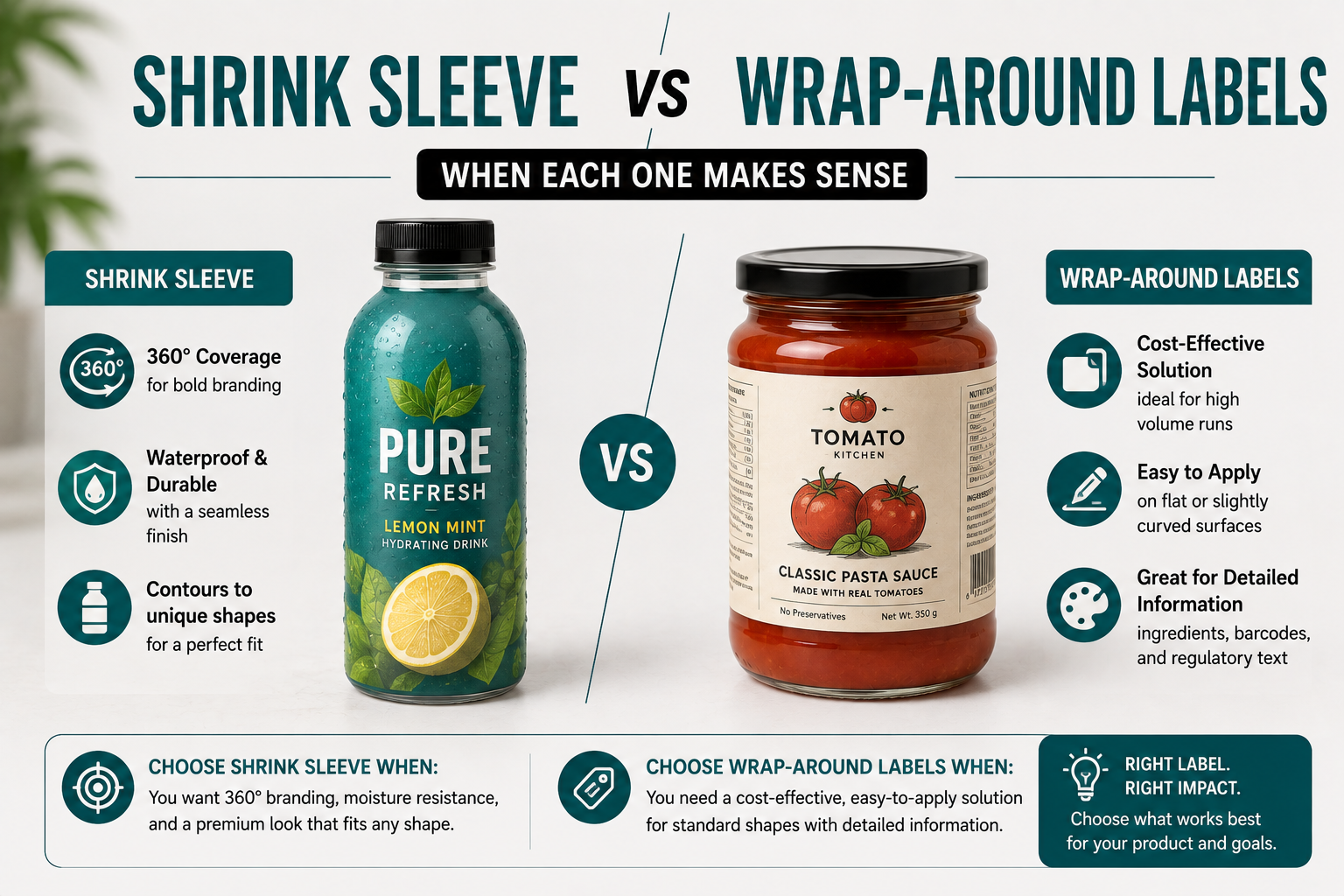
A shrink sleeve is printed on a heat-sensitive plastic film. The sleeve slides over the container, then passes through heat, usually a steam tunnel. The heat shrinks the film until it hugs every curve of the container, from the neck down to the base. There is no adhesive involved. The film grips the shape on its own.
This is why shrink sleeves work so well on containers with complex curves, tapers, or ridges, where a flat label would wrinkle or lift at the edges. Graphics are printed on the inside surface of the film, which protects the artwork from scuffing and moisture during shipping.
Shrink sleeves also give brands close to 360 degrees of usable print space, which is far more than most other label types offer.
What a Wrap-Around Label Actually Is
A wrap-around label is a pressure-sensitive label. It is printed flat, then applied around the container using adhesive and pressure, not heat. It also wraps a full 360 degrees, but it does not conform to the shape the way a shrink sleeve does. It works best on containers with a simple, consistent cylindrical shape, like most bottles, jars, and cans.
Because there is no heat-shrink step, the production process is simpler and the equipment needed is less specialised. This keeps both the design cost and the print cost lower than shrink sleeves, often by a meaningful margin.
Where the Real Differences Show Up
Cost
This is the first difference brands notice. A shrink sleeve typically costs more per container than a wrap-around label, often by around 25 percent, because of the film, the heat-application step, and the extra equipment involved.
Coverage
This is the second difference. On a straight-sided bottle, both options look almost identical once applied. On a bottle with curves, a narrow neck, or an irregular shape, a shrink sleeve holds its shape cleanly while a wrap-around label struggles to sit flat without wrinkling.
Tamper evidence
Shrink sleeves can be designed to show visible damage the moment a seal is broken, which is why they show up so often on drinks, supplements, and personal care products. Wrap-around labels do not offer this on their own.
Recyclability
This is a major difference and it cuts the other way. A wrap-around label is easier to separate from its container during recycling. A shrink sleeve, especially a full-body one, can make sorting harder unless the brand has chosen a sleeve material designed for clean separation.
Making the Right Call
Choose a shrink sleeve when the container has a complex shape, when full 360-degree branding matters more than cost, or when tamper evidence is a real requirement for the category. Beverage brands, supplement brands, and personal care brands lean toward shrink sleeves for exactly these reasons.
Choose a wrap-around label when the container is a standard cylindrical shape, when the budget needs to stay tight, or when the brand wants a simpler label to manage across multiple pack sizes. Food brands and household product brands often default to wrap-around labels because the container shapes are simple and the cost savings add up fast at volume.
Neither option is the better one in general. The container decides which one is the right one.
FAQs
Which is cheaper, shrink sleeve or wrap-around labels?
Wrap-around labels are almost always cheaper. Shrink sleeves typically cost around 25 percent more per container, mainly due to the film cost and the extra heat-application step in production.
Do shrink sleeve labels work on any container shape?
Yes, that is their main advantage. Shrink sleeves conform to curves, tapers, and irregular shapes that a flat wrap-around label cannot sit cleanly on.
Are shrink sleeve labels tamper-evident?
They can be, when designed for it. A shrink sleeve can be built to visibly tear or show damage the moment a container is opened, which is why they are common on drinks, supplements, and personal care products.
Which label type is easier to recycle?
Wrap-around labels are generally easier to separate from a container during recycling. Shrink sleeves, particularly full-body ones, can complicate recycling unless the film is specifically designed for clean separation.