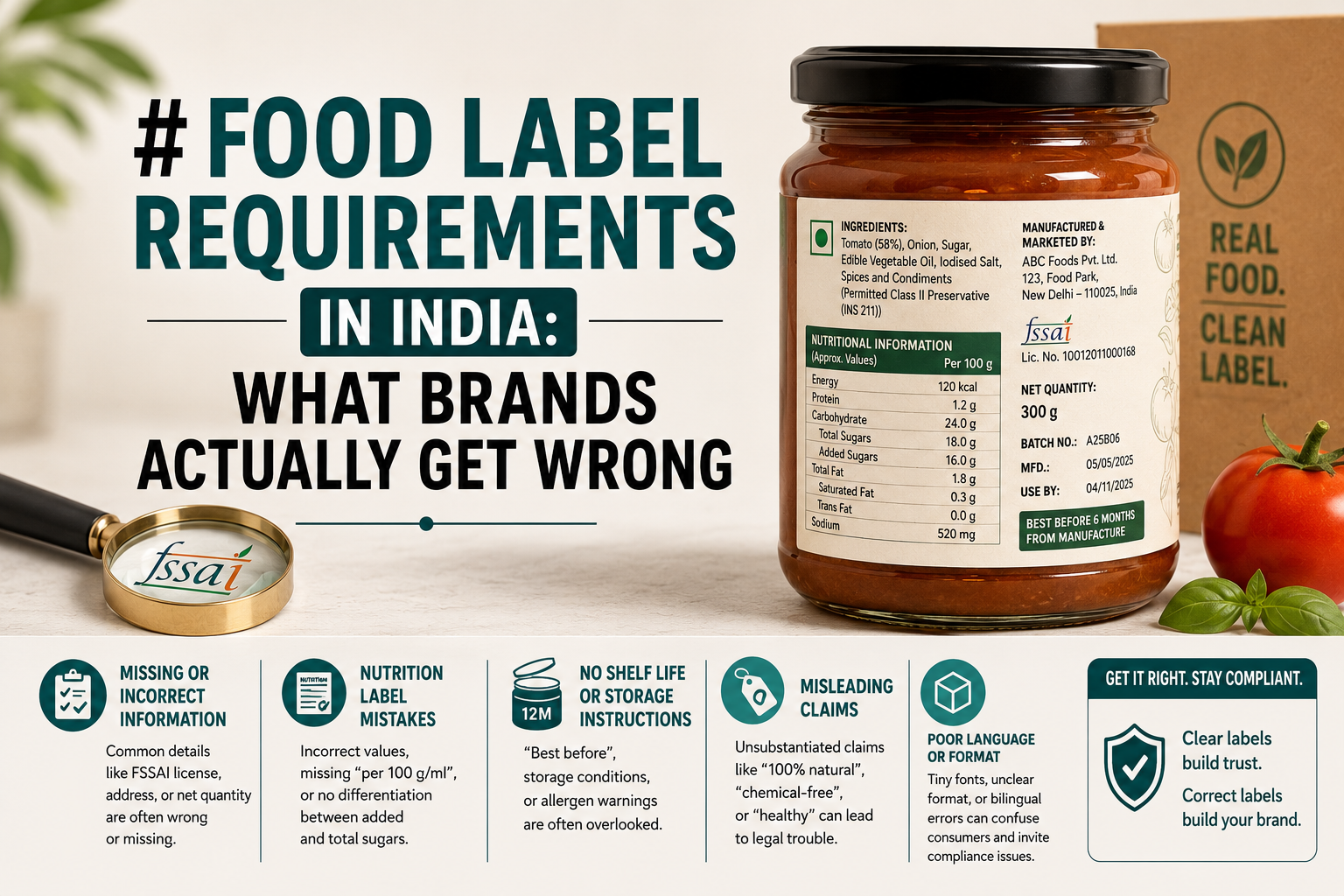

A food label is not a design piece. It is almost a legal document. In India, every packaged food product must follow the Food Safety and Standards (Labelling and Display) Regulations, 2020. These rules are enforced by FSSAI, the Food Safety and Standards Authority of India. Get a label wrong, and the risk is not a bad review. It is product seizure, a fine, or in serious cases, prosecution under the Food Safety and Standards Act, 2006. Most brands do not break these rules on purpose. They get tripped up by details that seem small at the design stage but matter a lot at the compliance stage. To understand the food label requirements in India in detail, let’s look at the mistakes that come up again and again.
Mistake 1: Font Size That Doesn’t Scale to the Pack
FSSAI sets minimum font sizes for mandatory information, and that size is not fixed. It scales with the area of the principal display panel. A label that looks fine on a large pouch can fail compliance the moment the same design gets shrunk onto a smaller sachet. Brands often design one master label and resize it across pack formats without checking whether the text still meets the minimum height rule. This is one of the most common reasons a label passes review on paper but fails on the actual printed product.
Mistake 2: Getting the Veg or Non-Veg Symbol Wrong
Every packaged food product needs the veg or non-veg symbol. A green circle inside a green square for vegetarian. A brown triangle inside a brown square for non-vegetarian. This sounds simple, but the size of the symbol is not left to design taste. It is tied directly to the size of the display panel. Brands frequently shrink this symbol too far when space is tight, or place it somewhere inconsistent across different SKUs in the same product line. Small and inconsistent both count as non-compliant.
Mistake 3: Allergens Listed but Not Actually Highlighted
Allergen information is a common failure point. FSSAI requires major allergens to be highlighted in bold, italic, or a different colour inside the ingredients list. On top of that, a separate “Contains” statement must appear near the ingredients list. Many labels get half of this right. They list the allergen inside the ingredients but skip the bold formatting, or they add bold text but forget the separate statement. Both are incomplete under current rules, and both are easy to catch during an inspection.
Mistake 4: A Product Name That Oversells the Product
The name on the front of a pack has to reflect what is actually inside. This trips up beverage and snack brands more than any other category. A drink with a small percentage of real fruit content cannot call itself “Mango Juice.” It has to be labelled a “fruit drink” or similar, based on its actual composition. Brands sometimes choose a name that fits the marketing story better than it fits the product. That gap between name and content is exactly what regulators look for first.
Mistake 5: Manufacturer Details and Dates That Don’t Hold Up
The full name and address of the manufacturer or packer must appear on the label. If a product is made under contract, the label needs to say so clearly, naming both the manufacturer and the brand owner. Date formatting causes trouble too. Best Before and Use By dates need a clear, consistent format, and the FSSAI license number, a 14-digit number starting with 1 or 2, needs to be printed accurately and kept close to the FSSAI logo. Small transcription errors here are common when brands switch manufacturing partners or update packaging in a hurry.
Why This Belongs at the Printing Stage, Not After
FSSAI also updates these rules more often than most brands expect. A 2026 amendment has already added new traceability requirements for non-retail containers, along with revised exemptions and warning rules for certain product categories. Front-of-pack labelling for high sugar, salt, and fat products is also moving toward becoming mandatory. A label that was compliant last year is not guaranteed to be compliant this year. The safest approach is to treat every new print run as a chance to check the label against the current rules, not just the design file from the last order.
FAQs
What happens if a food label in India doesn’t meet FSSAI requirements?
Non-compliant labels can lead to product seizure, monetary fines under the Food Safety and Standards Act, and in serious cases of misleading claims, criminal prosecution. Repeated violations can also affect a brand’s FSSAI license status.
Does allergen information have to be bold on Indian food labels?
Yes. FSSAI requires major allergens to be highlighted in bold, italic, or a different colour within the ingredients list, along with a separate “Contains” statement placed near the ingredients list.
What is the correct format for the veg or non-veg symbol?
Vegetarian products use a green circle inside a green square. Non-vegetarian products use a brown triangle inside a brown square. The size of this symbol is set relative to the size of the principal display panel, not a fixed dimension.
Is front-of-pack warning labelling mandatory in India yet?
Front-of-pack labelling for products high in sugar, salt, or saturated fat is still being finalised. Food brands should prepare for mandatory display rules in this area, since FSSAI has signalled this as an active area of regulatory change.