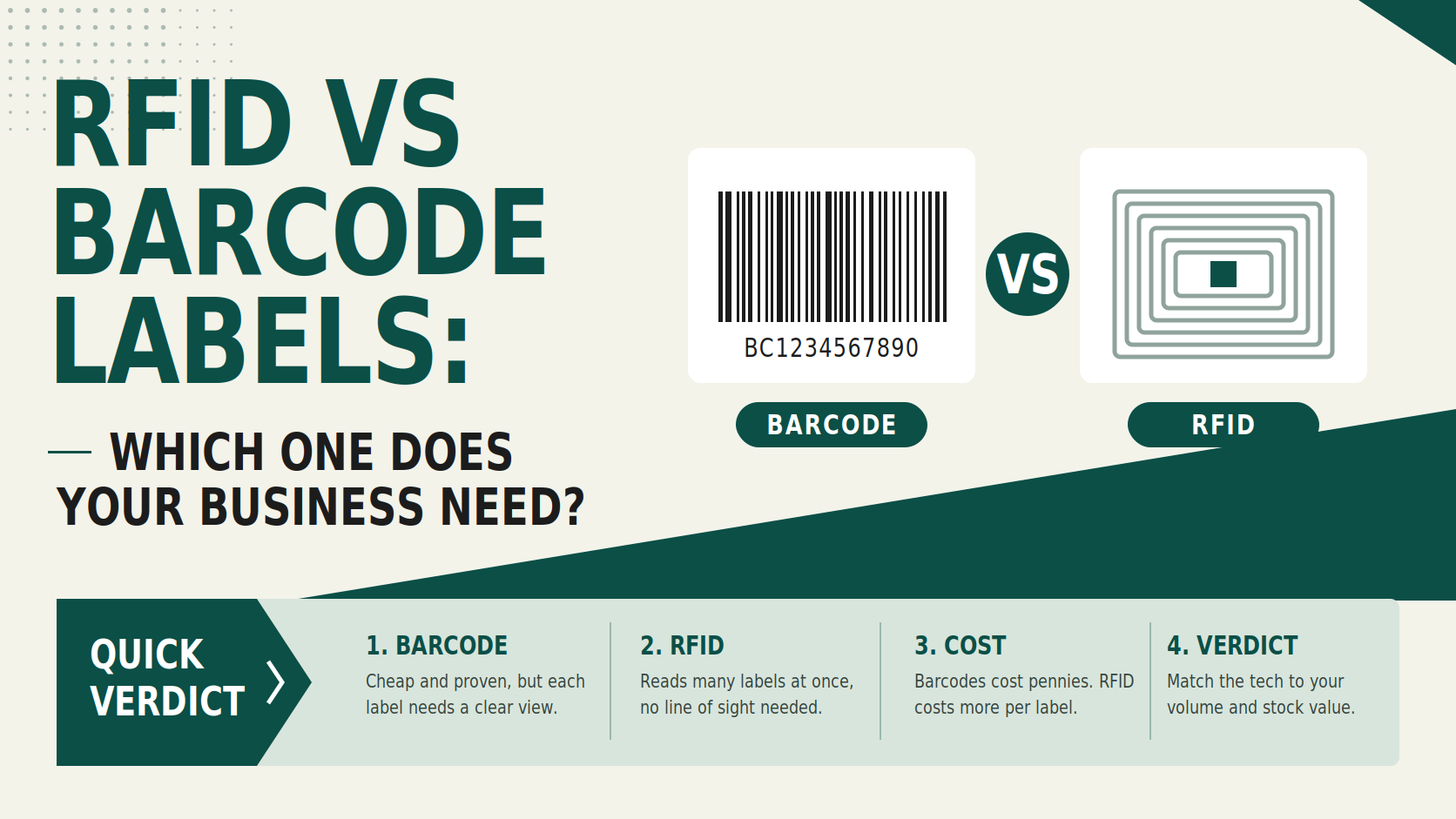

A lot of businesses find themselves stuck on the question, whether they should use RFID or barcode. To make it simple, choose barcode labels if you need a cheap, reliable way to identify products and you can scan items one by one. Choose RFID labels if you need to read many items fast, without line of sight, or track each item individually. Many businesses use both. So, let’s understand RFID vs barcode labels.
The Real Question Is Not “Which Is Better”
RFID sounds more advanced, so many buyers assume it is the better choice. It is not always. It is better at some jobs and a waste of money at others.
The right question is this: what problem are you trying to solve? Once you know that, the choice gets simple.
How Each One Works, In Brief
A barcode is a printed pattern. A scanner shines light on it, reads the lines or squares, and turns them into a number. The scanner must see the code clearly.
An RFID label has a tiny chip and antenna inside. A reader sends out radio waves, and the chip replies with its ID. No line of sight is needed.
Barcode: Where It Wins
Barcodes are cheap. They are printed with the rest of your label, so the extra cost is close to nothing. That matters when you sell low-priced products in large numbers.
They are also universal. Almost every shop, warehouse and billing system can read them. Retail products in India usually carry a GS1 barcode so that any store can scan them. Standards like this keep things simple for you and your partners.
Barcodes can also carry more than one kind of data. A 1D barcode, the classic striped type, holds a short number. A 2D code, like a QR code or Data Matrix, can hold much more, such as batch numbers, expiry dates or a web link.
The weak spots are clear. Each code must be scanned one at a time. A torn, smudged or hidden barcode fails. And many items share the same code, so you can’t tell two identical packs apart.
RFID: Where It Wins
RFID is fast. A reader can pick up many labels at once, even inside closed cartons. A stock count that takes hours with a scanner can take minutes.
It is also more detailed. Each chip has its own unique ID. You can track one single item, not just one product type. This helps with batch tracking, anti-counterfeit checks and finding lost stock.
The weak spots matter just as much. RFID labels cost more than barcode labels. Metal and liquids can disturb the signal, so tags for those surfaces need special design. You also need readers and software, which adds setup cost. And results depend on testing, as read range changes with the tag, reader and surroundings.
Side-By-Side Comparison
| Barcode | RFID | |
| Cost per label | Very low | Higher |
| Needs line of sight | Yes | No |
| Reads many at once | No | Yes |
| Tracks single items | Usually no | Yes |
| Works on metal and liquids | Yes | Needs special tags |
| Equipment needed | Simple scanner | Reader and software |
| Best for | Retail, billing, simple tracking | Stock counts, logistics, high-value items |
Which One Fits Your Business?
Take a small food or cosmetics brand selling through shops. Barcodes are enough. Retailers need them anyway, and the cost stays tiny.
Now take a clothing brand with thousands of items in a store, or a warehouse that ships pallets to many buyers. Counting by hand, or scanning one by one, burns time and creates errors. RFID can pay for itself here.
Pharma and high-value goods sit in between. A barcode or QR code may handle batch and expiry data well. RFID can add item-level tracking where the product value or risk justifies it.
A simple test helps. Write down how many hours you spend each month counting, locating or checking stock, and what mistakes cost you. If the number is small, stay with barcodes. If it is large, ask for an RFID trial.
You Don’t Have To Choose Just One
Many businesses use both. The barcode stays on the label as a backup and for retail checkout. The RFID chip handles fast counting and tracking inside the supply chain.
This also lowers risk. If a reader is down, someone can still scan the barcode.
A Smart Way To Start
Don’t switch everything at once. Pick one product line or one warehouse area. Run a small RFID trial on your real packs with a real reader. Compare the results with your current barcode process. Then decide.
Also make sure your barcode prints well. Use dark bars on a light, matte background, leave clear space around the code, and test with a scanner. A good barcode on the wrong surface still fails. This is a common problem on shiny labels.
Frequently Asked Questions
Is RFID going to replace barcodes?
Not soon. Barcodes are cheap, universal and good enough for many jobs. RFID is growing where speed and item-level tracking matter, but the two usually work side by side.
Can one label have both a barcode and an RFID chip?
Yes. The chip sits inside the label, and the barcode is printed on top. This is a common setup, and it gives you a backup if the reader isn’t available.
Is RFID too expensive for small businesses?
Often it is, at least for simple products. The label costs more, and you also need readers and software. A small business with a few products usually gets better value from barcodes first.
Which is more accurate, RFID or barcode?
Both are accurate when used well. RFID cuts human error in counting, since it reads many items without manual scanning. Barcodes are very reliable if printed clearly and scanned properly.
Not sure which one your business needs?
Tell the Winways Digitech team what you sell, how you store it and how you track it today. We will help you compare options and test samples on your real packs. Reach us through the contact page on our website.