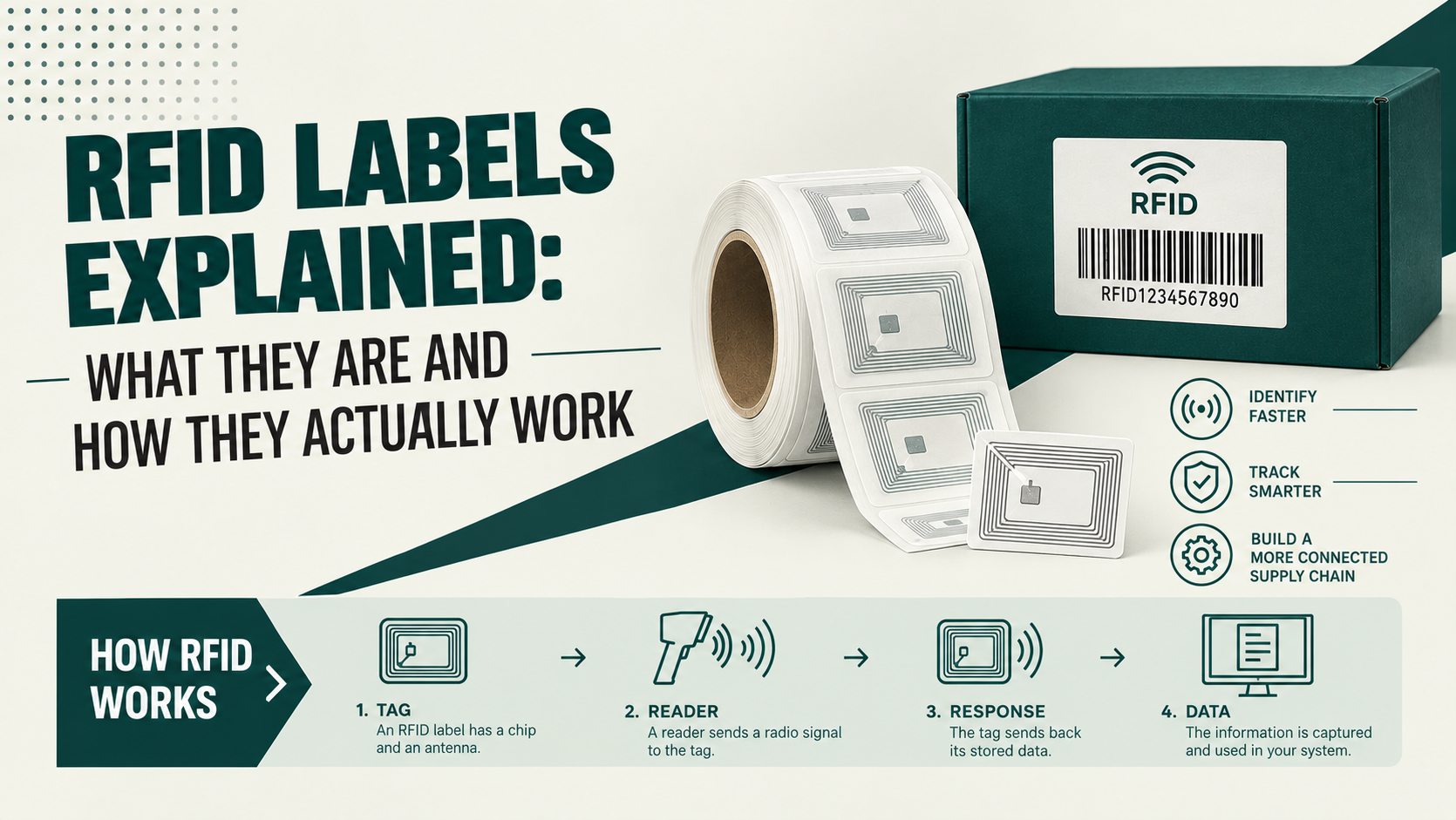

An RFID label is a normal adhesive label with a tiny chip and antenna inside. A reader sends out radio waves, the chip answers with its ID number, and no line of sight is needed. That means you can read many labels at once, even inside a closed carton.
What Is An RFID Label?
RFID stands for radio frequency identification. An RFID label looks like any other label. Inside it sits a thin layer called an inlay. The inlay holds two parts: a small chip and an antenna.
The chip stores a unique number. The antenna lets the chip talk to a reader. On top of the inlay goes the face material and the adhesive, so you can stick it on a pack like any other label. You can still print a logo, text and even a barcode on the surface.
How Does It Work?
Most RFID labels are passive. This means they have no battery. They wake up only when a reader is near.
The process has four steps. The reader sends out radio waves. The antenna in the label picks up that energy. The energy powers the chip for a split second. The chip then sends its number back to the reader.
The reader passes that number to software. The software looks it up and shows what the item is, where it came from and where it has been. All of this takes a fraction of a second.
RFID Labels vs Barcode Labels: What Actually Changes?
A barcode needs a clear view. Someone has to point a scanner at each label, one by one. If the label is hidden, torn or dirty, it fails.
RFID doesn’t need to see the label. A reader can pick up many tags at once, even through cartons. Think of counting a full shelf of stock by walking past it, instead of scanning each pack.
RFID also stores more. Each chip has its own unique ID. Two cartons of the same product can be told apart. A barcode usually can’t do that.
The trade-off is cost. RFID labels cost more than barcode labels. For low-value, fast-moving packs, a barcode is often enough. RFID makes sense when time, accuracy or tracking matter more than the label price.
The Three RFID Frequencies
Not all RFID is the same. The frequency decides how far a tag can be read and what it suits.
| Type | Frequency | Typical read range | Common use |
| Low frequency (LF) | 125–134 kHz | A few centimetres | Animal tags, access cards |
| High frequency (HF/NFC) | 13.56 MHz | Up to about a metre | Library books, tickets, tap-to-read |
| Ultra high frequency (UHF) | 860–960 MHz | Several metres | Retail, logistics, warehouses |
In India, UHF RFID runs in the 865–867 MHz band. Most label-based tracking for packaged goods uses UHF, because it reads fast and from a distance. Range depends on the tag design, the reader and the surroundings, so treat the numbers as a guide.
Where Are RFID Labels Used?
Retail and apparel use them for quick stock counts and to prevent mis-shipments. Warehouses use them to track cartons and pallets without opening them. Pharma brands use them to track batches and check authenticity. Libraries, events and logistics companies use them to speed up counting and entry.
For a label buyer, the question is simple. Do you lose time or money counting, finding or checking items? If yes, RFID may be worth a look.
What Can Go Wrong?
RFID is good, but it has weak spots. Knowing them saves money.
Metal and liquids are the biggest problem. Metal reflects radio waves. Water and many liquids absorb them. A standard tag stuck on a metal tin or a bottle of liquid may read poorly. Special tags are built for these surfaces, so tell your printer what the pack is made of.
Tag placement also matters. A tag in the wrong spot, or too close to another tag, can cause weak reads. Test on real packs, not on a table.
Finally, the label must survive its journey. Heat, moisture, cold storage and rough handling can damage the label or the chip. Choose the face material and adhesive for the real conditions.
How to Start Without Wasting Money
Begin with one use case, such as stock counting for one product line. Test a small batch of tags on your real packs, with your real reader, in your real warehouse. Check the read rate, then scale up.
Also check that your tags follow a common standard. Most UHF tags follow EPC Gen2, also known as ISO/IEC 18000-63. GS1 sets the rules for the numbering systems used in retail supply chains. Standards keep your tags working with different readers and partners.
Frequently Asked Questions
Does an RFID label need a battery?
Most don’t. Passive RFID labels get their power from the reader’s radio waves. Battery-powered tags exist, but they are bulkier and costlier, and they suit special uses like tracking vehicles or containers.
Can RFID labels also carry a barcode and printed text?
Yes. The chip is inside the label, so the top surface can still carry a logo, text and barcode. Many brands keep the barcode as a backup in case a reader isn’t available.
Will an RFID label work on metal or liquid packs?
A normal tag may not. Metal and liquids interfere with the signal. Tags made for metal or liquid surfaces solve this, so share your pack details before ordering.
Is RFID worth the extra cost over barcodes?
It depends on the job. For cheap, simple packs, barcodes are usually enough. For high-value items, large stock counts or batch tracking, RFID often saves more time and error than it costs.
Thinking about RFID for your products?
Tell the Winways Digitech team about your pack, surface and how you plan to track it. We will help you pick the right tag and test a sample first. Reach us through the contact page on our website.