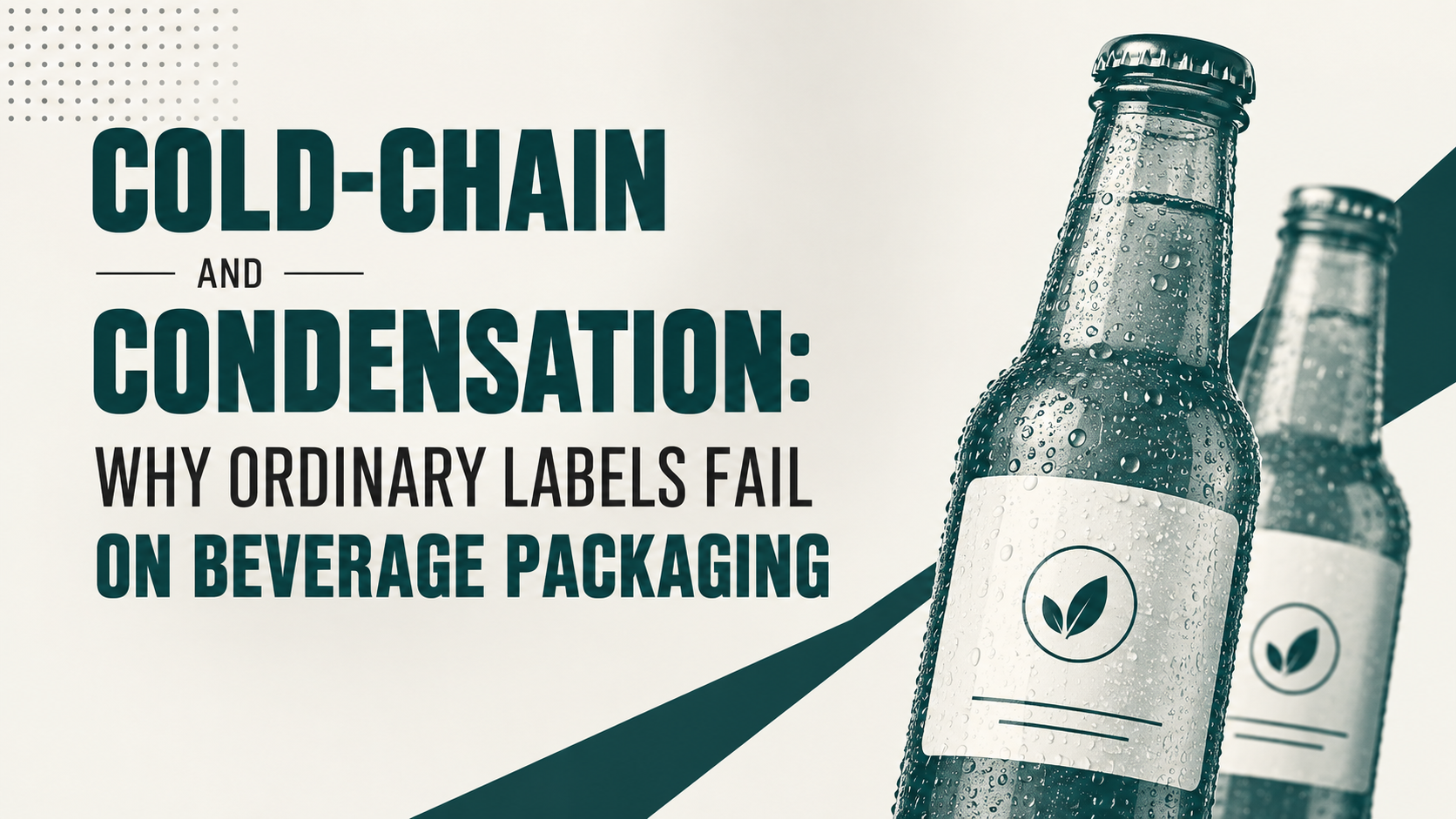

A label can pass every check in the warehouse and still fail within hours of reaching a refrigerated case. It lifts at the edge or it slides off entirely and, this is not an isolated defect. It is a predictable outcome of a mismatch between the label specification and the cold, wet environment the product actually moves through. Understanding the mechanism behind this failure, and where standard specifications fall short, is the first step to preventing it. So let’s see how labels, cold-chain, and condensation work together.
The Real Cause: A Condensation Layer, Not a Weak Adhesive
Most teams assume a peeling label points to a weak adhesive. That is only part of the picture. Cold surfaces attract moisture from the surrounding air. That forms a thin film of condensation or, in colder conditions, a layer of frost. When we apply a label over this layer, the adhesive bonds to the moisture rather than to the container itself. Once that moisture layer melts or shifts, the label loses its anchor and detaches. This is why a label can appear correctly applied at the point of packing and still fail within a day or two in cold storage. The failure is not sudden. It is built in from the moment of application.
Cold-Fill and Cold Storage Are Not the Same Specification
People treat these two conditions as interchangeable, and that assumption causes real problems. Cold-fill refers to labelling a container that is already cold, directly off the filling line. Cold storage refers to labelling at room temperature, with the container chilled or frozen afterward. Each condition places a different kind of stress on the adhesive. A label engineered for cold storage can still fail under cold-fill conditions. It’s simply because the surface is already cold and damp at the moment of contact. Brands need to specify which condition applies to their production line when briefing a label supplier. This distinction, more than any other single factor, determines whether a label performs as expected in the field.
An Ice Bucket Is a More Demanding Test Than a Refrigerated Case
Not all cold exposure carries equal risk. A bottle in a refrigerated case contends with cool air and moderate condensation. A bottle placed in an ice bucket contends with something considerably harder to manage. It’s battling partial submersion in melting ice for an extended period. This represents a materially tougher test for adhesive performance. A label that passes standard refrigeration testing can still fail under ice bucket conditions, because the two environments are not comparable. Brands whose products are likely to end up in ice-filled coolers should validate against that exact scenario before committing to a full production run, not after field complaints surface.
Paper Was Never Engineered for This Environment
Paper labels remain popular for their low cost and print quality, but paper absorbs moisture in a way that makes it fundamentally unsuited to cold, wet conditions. Exposure to condensation causes paper to swell, wrinkle, or soften, and print quality degrades along with it. Synthetic facestocks, such as BOPP or polyester film, do not absorb moisture. They retain their shape and structural integrity even after extended contact with condensation or ice. For any beverage product that will spend meaningful time cold and wet, paper is the wrong starting material, regardless of how well-suited the adhesive underneath it might be.
Specify for the Worst-Case Scenario, Not the Average One
The most reliable approach is to specify a label for the hardest condition it will realistically face, not the condition it encounters most often. If a bottle may sit in an ice bucket for several hours at an event, that scenario should be part of the testing protocol. If containers are labelled cold on the filling line, that detail needs to reach the label supplier at the briefing stage, so the adhesive is selected for that exact point of contact. A cold-chain label specification is an engineering decision, not a design preference, and it should be validated as one before it enters full production.
FAQs
Why do beverage labels peel off in refrigerated storage?
This typically occurs because moisture or frost forms on the container’s surface before or after the label is applied. The adhesive bonds to that thin moisture layer rather than to the container itself, so it loses its grip once the moisture shifts or melts.
What is the difference between cold-fill and cold storage labelling?
Cold-fill involves applying a label to a container that is already cold, directly off the filling line. Cold storage involves applying a label at room temperature, with the container chilled or frozen afterward. Each scenario requires a different adhesive specification.
Can a label pass refrigeration testing but still fail in an ice bucket?
Yes. Ice bucket exposure involves prolonged contact with melting ice and standing water, which is a more demanding test than typical refrigerated condensation. A label validated only for refrigeration conditions can still fail under ice bucket conditions.
Why are paper labels unsuitable for cold-chain beverage packaging?
Paper absorbs moisture, causing it to swell, wrinkle, or soften in cold, wet conditions. Synthetic facestocks such as BOPP or polyester do not absorb water, allowing them to remain flat and intact through condensation, ice contact, and freeze-thaw cycles.