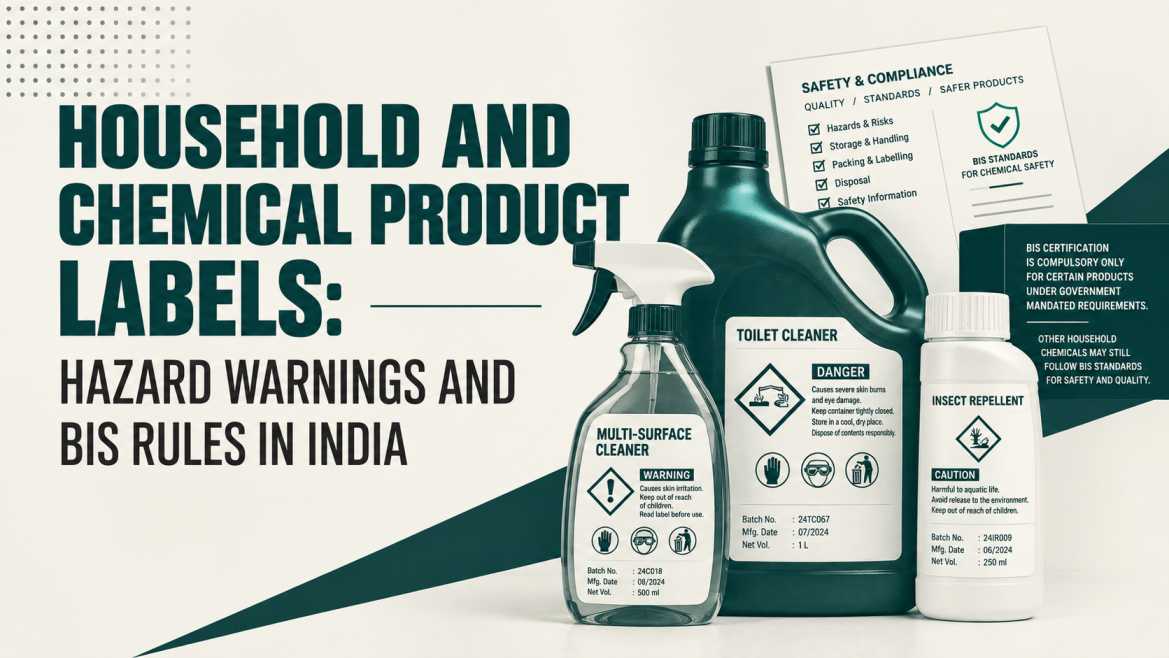

Brands entering the household and chemical product space often assume India has one clear rulebook for hazard labelling, the way the US and EU rely on GHS. It does not. What exists instead is a patchwork of laws that don’t exactly work together as a single hazard labelling framework. That gap is exactly where brands run into avoidable risk. Understanding what you actually require, versus what is simply good practice, is the difference between a defensible label and one that only looks compliant. Let’s understand household and chemical product labels rules in details.
India Has Not Formally Adopted GHS
The Globally Harmonized System of hazard classification, familiar from US and EU chemical labels, has not been officially adopted in India. A draft law, the Chemicals (Management and Safety) Rules, was published in 2020 and would align India with GHS once finalised. But it’s still in its draft form. The current governing regulation for hazardous chemicals is the Manufacture, Storage and Import of Hazardous Chemicals Rules, 1989. It focuses on industrial handling and safety data sheets rather than retail-facing hazard labels on consumer packaging. This leaves a real gap for household and chemical brands selling directly to consumers. The law most people assume applies simply does not, not yet.
Legal Metrology Does Not Require a Hazard Warning
This surprises most brands. The Legal Metrology (Packaged Commodities) Rules govern mandatory declarations like net quantity, manufacturer details, and MRP. They do not explicitly list a hazard or precautionary warning as a mandatory declaration. A cleaning product or pesticide can technically satisfy every item on the Legal Metrology checklist without carrying a single word of hazard warning on its label. That gap does not mean hazard warnings are optional in any meaningful sense. It means the requirement to warn consumers does not come from Legal Metrology law at all. It comes from somewhere else.
The Consumer Protection Act Creates the Real Exposure
The Consumer Protection Act, 2019 introduced product liability provisions. They hold manufacturers and sellers responsible for harm caused by a defective product, including harm caused by inadequate instructions or missing warnings. This is where the actual legal risk sits for household and chemical brands. No single law spells out exactly which hazard pictograms or precautionary statements a label must carry. A brand that sells a corrosive, flammable, or toxic product without clear warning language is exposed to liability under product liability law the moment that product causes harm. The absence of a specific hazard-labelling mandate is not protection. It is a gap that shifts the risk onto the brand rather than removing it.
BIS Standards Still Apply, Product by Product
The Bureau of Indian Standards maintains specific IS standards for individual product categories. This includes detergents, disinfectants, and various household chemical formulations. These standards often include labelling and safety requirements specific to that product type. Pesticides carry their own separate regulatory layer entirely, governed by the Insecticides Act, 1968. It mandates specific warning language and precautions. This means hazard labelling compliance in India cannot be handled with one generic template. It has to be checked category by category. A detergent, a disinfectant, and a pesticide can each fall under different standards with different specific requirements.
The Safest Approach Is to Exceed the Minimum
Given this patchwork, the most defensible position for a household or chemical brand is to voluntarily follow GHS-style labelling conventions. Label should have clear signal words, precautionary statements, and a “keep out of reach of children” warning, even where no single Indian law explicitly demands it. This does two things at once. It closes the product liability exposure created by the Consumer Protection Act, since a label with clear warnings is far harder to argue as inadequate. It also positions the brand ahead of the eventual GHS-aligned regulation, so a future compliance deadline does not force a costly relabelling exercise across an entire product line.
FAQs
Is GHS hazard labelling mandatory in India?
Not yet. India has not formally adopted GHS. A draft law, the Chemicals (Management and Safety) Rules, would align India with GHS standards once finalised, but as of now, GHS-style labelling remains a voluntary best practice rather than a legal requirement.
Does Legal Metrology law require hazard warnings on household chemical labels?
No. The Legal Metrology (Packaged Commodities) Rules do not explicitly list a hazard or precautionary warning among mandatory label declarations. This does not mean warnings are unnecessary, since separate liability law creates strong incentive to include them.
Can consumer hold a brand liable for harm even without a specific hazard-labelling law?
Yes. The Consumer Protection Act, 2019 holds manufacturers and sellers liable for harm caused by inadequate warnings or instructions, regardless of whether a specific labelling law mandated that exact warning. This is the primary source of legal exposure for household chemical brands in India today.
Do BIS standards apply to household chemical products?
Yes, for many categories. The Bureau of Indian Standards maintains specific IS standards for products like detergents and disinfectants, often including labelling requirements, while pesticides fall under the separate Insecticides Act, 1968. You need to check compliance asper product category, not through a single generic standard.