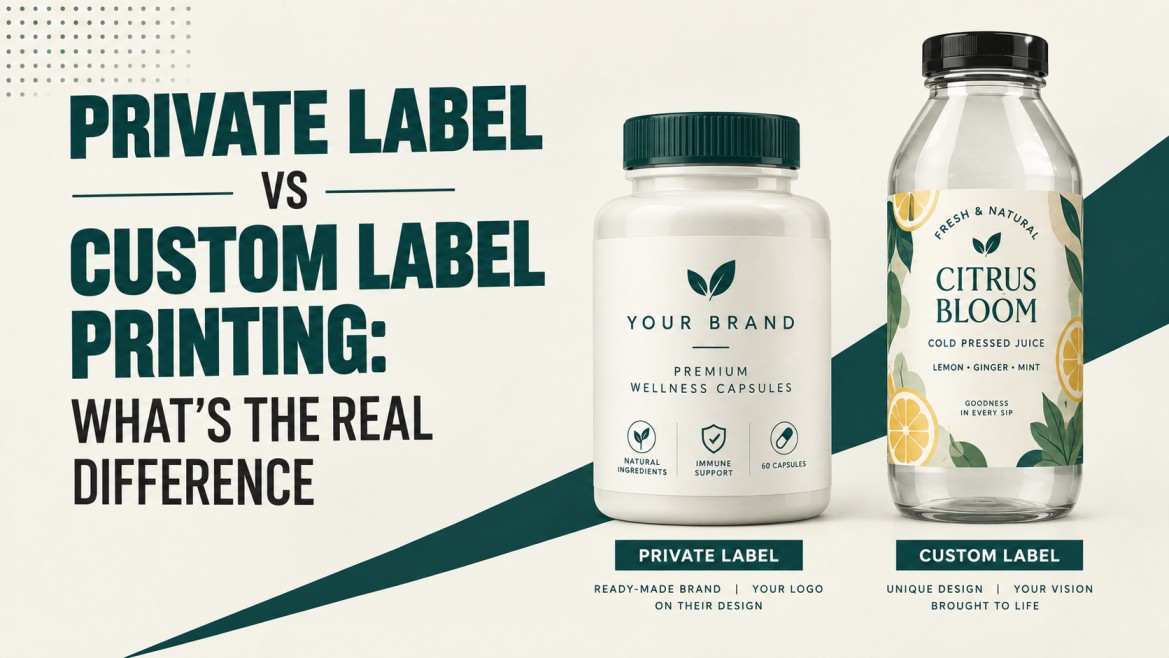

New brand founders often treat these two terms as competing options, as if choosing one rules out the other. That framing is incorrect. It leads to real confusion during sourcing and launch planning. Private label and custom label printing describe two entirely different decisions. One is about where your product comes from. The other is about how your label gets produced. Understanding the difference prevents a common and costly mix-up early in a brand’s life.
Private Labelling Is a Decision About the Product
Private labelling means partnering with a manufacturer who already produces a formulation or product. Then a brand can sell it under their own brand name. This is common across cosmetics, food, supplements, and household goods. A manufacturer runs an existing production line and simply packs the output under different brand identities for different clients.
The appeal is speed and lower upfront investment. A brand does not need to develop a formulation, build manufacturing capacity, or manage production from scratch. The trade-off is that the core product is usually shared, in some form, across multiple brands using the same manufacturer, which limits how differentiated the product itself can be.
Custom Label Printing Is a Decision About Production
Custom label printing has nothing to do with where the product comes from. It refers to designing and printing a label built to an exact specification, covering size, shape, material, finish, and compliance requirements. The printer matches it precisely to a specific container and brand identity. This decision applies whether a brand manufactures its own product from scratch or sources it through a private label arrangement.
A custom label is a production choice that a label printer makes. It is not a sourcing choice with a product manufacturer, and the two processes typically involve entirely different partners.
Nearly Every Private Label Brand Still Needs a Custom Label
This is where the confusion usually causes real problems. Private labelling does not remove the need for a custom label. In most cases, it makes custom labelling more important, not less.
Since the underlying product may be similar to what a manufacturer supplies to other brands, the label often becomes the primary point of differentiation on the shelf. A generic or stock label undercuts the entire point of private labelling, which is to build a distinct brand identity around a sourced product.
Brands that treat labelling as an afterthought, assuming the manufacturer’s standard label will suffice, frequently end up with packaging that looks indistinguishable from a competitor using the same production line.
Where This Mix-Up Actually Costs Brands
Two mistakes show up repeatedly. Some private label brands default to a manufacturer’s stock label to save time. They may later discover it does not reflect their specific formulation, does not meet the compliance requirements for their exact product claims, or does nothing to build brand recognition. Other brands assume that because they are manufacturing their own unique product, they need to go through a formal private labelling program to get proper labels made, when what they actually need is simply a direct relationship with a custom label printer. Both mistakes come from treating sourcing strategy and label production as the same decision, when they are two separate steps in the process, often handled by two entirely different partners.
The Two Decisions, Kept Separate
Private label answers the question of who makes your product. Custom label printing answers the question of how your label gets made once you know what the product is. They intersect constantly, since almost every product, private-labelled or fully manufactured in-house, eventually needs a label built to its exact specification. But they are not substitutes for each other, and keeping that distinction clear from the start avoids both wasted time and a launch that looks less differentiated than it needed to.
FAQs
Can a private label product have a custom-printed label?
Yes, and in most cases it should. Private labelling determines who manufactures the underlying product. A custom label is a separate decision about how that product’s packaging is designed and printed, and it is usually essential for building a distinct brand identity around a sourced product.
Is private labelling cheaper than manufacturing your own product?
Generally yes, since private labelling avoids the cost of developing a formulation and building production capacity. However, this cost saving applies to the product itself, not to labelling. That remains a separate expense regardless of the sourcing model chosen.
Do private label brands need to worry about label compliance?
Yes. Compliance requirements are tied to the specific product, its formulation, and its claims. It’s not tied to whether it was manufactured in-house or sourced through a private label arrangement. A private label brand is still fully responsible for its label meeting all applicable regulations.
What is the main difference between private label and custom label printing?
Private label refers to sourcing a product from an existing manufacturer and selling it under your own brand. Custom label printing refers to designing and producing a label built to an exact specification for that product. One is a sourcing decision, the other is a production decision, and most brands need both.